Waste Management and Feminist Perspectives from Cambodia and Beyond
An editorial reflection by Heike Löschmann
Who profits from plastic, and who bears its costs? A newly published Heinrich Böll Foundation study by Birte Rodenberg examines the global plastics crisis through a feminist political economy lens, tracing how environmental harm, labour burdens and care responsibilities are distributed unequally across the lifecycle of plastics. In dialogue with recent research from Cambodia on waste management, gender and zero waste approaches, it opens new perspectives on plastic pollution as a question not only of waste, but of power, inequality and environmental justice.

Plastic pollution begins long before waste reaches a landfill, river or coastline.
The global plastics crisis begins with fossil fuel extraction, expands through systems of industrial production and mass consumption, and persists through unequal realities of waste management, toxic exposure and environmental degradation. Increasingly, researchers and environmental movements argue that plastic pollution must be understood not only as an environmental issue but also as a question of justice.
A newly published study commissioned by the Heinrich Böll Foundation in cooperation with partners and offices worldwide, Combatting Global Plastic Pollution — Feminist Perspectives for a Gender-Just Approach, by Birte Rodenberg, examines the global plastics crisis through a feminist lens. Drawing on experiences and perspectives from different regions, it explores how gender, labour, care and environmental justice intersect across the lifecycle of plastics.
More than a study about waste management, Rodenberg's contribution invites readers to rethink the plastic crisis through the lens of power, labour and social inequality. Moving beyond familiar debates about recycling and consumer behaviour, it traces the entire lifecycle of plastics — from fossil fuel extraction and industrial production to consumption, disposal and recycling — revealing how the environmental and social costs of plastics are systematically shifted onto communities, workers and ecosystems. By linking plastic pollution to questions of gender, care work, informal labour and environmental justice, the publication offers a powerful political economy perspective on a crisis that is too often reduced to questions of individual responsibility. In doing so, it opens new ways of understanding both the causes of plastic pollution and the transformations needed to address it.
The environmental and social costs of plastics are systematically shifted onto communities, workers and ecosystems.
These dynamics are not abstract global trends. They are also visible in everyday realities across Cambodia.
In 2025, Heinrich Böll Stiftung Cambodia published a three-part research series by Marie Kaiser, exploring the intersections of Zero Waste approaches, gender and waste management in Cambodia. Taken together, the contributions demonstrate how environmental questions are closely linked to labour systems, urban inequality, informal economies and social invisibility.
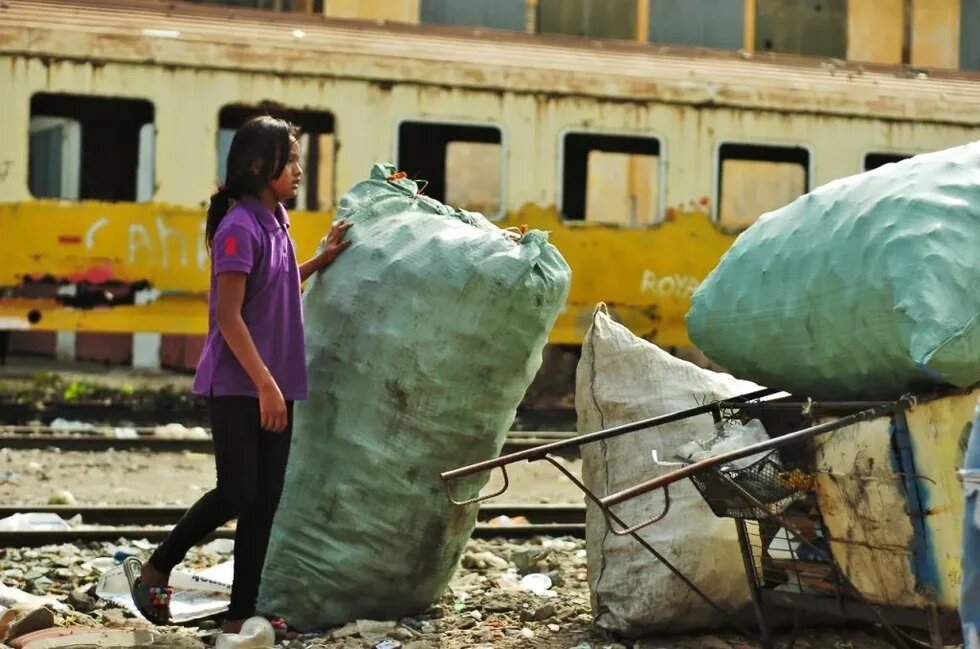
Across Cambodian cities, waste management depends heavily on informal and low-paid labour. Waste pickers, collectors, sorters and recyclers perform essential environmental work under often precarious conditions. Much of this labour remains socially invisible despite playing a crucial role in reducing waste and maintaining urban functionality. As documented in the article Horns and Headlamps: Cleaning Cambodia's Recyclable Trash, informal waste pickers known as “Edjai” travel through neighbourhoods collecting recyclable materials that feed Cambodia's recycling economy while helping keep streets and communities clean. Their work illustrates both the environmental value and the social invisibility that often characterize informal waste labour.
Women are strongly represented in many forms of informal waste-related work while also facing unequal access to resources, safer working conditions and economic opportunities.
These realities are explored further in the Gendered Landscape of Waste Management in Cambodia. It examines how informal waste economies shape everyday urban life while reproducing unequal environmental and social burdens.
The responsibility for the plastic crisis is frequently shifted onto consumers, local communities and informal workers.
Plastic consumption, meanwhile, continues to grow rapidly. Single-use packaging and disposable products have become deeply embedded in everyday life, driven by convenience-based consumption and expanding urban economies. Yet recycling systems alone are unable to keep pace with the increasing volume of plastic waste, and they are minimal in Cambodia´s waste management approach. As highlighted, both in global debates and Cambodian experiences, responsibility for the plastic crisis is frequently shifted onto consumers, local communities and informal workers, while the structural drivers of overproduction and unsustainable consumption remain insufficiently addressed.
This raises broader questions about how waste itself is understood. Waste management is not only a technical or infrastructural issue. It is also connected to care work, public health, labour divisions and unequal access to environmental resources and decision-making.
The structural drivers of overproduction and unsustainable consumption remain insufficiently addressed.
The contribution Nexus Gender & Waste further explores how gender perspectives can help reveal hidden dimensions of waste systems — including invisible labour, differentiated exposure to environmental risks and the unequal distribution of responsibility for managing everyday waste.
At the same time, environmental movements around the world increasingly emphasize that recycling alone cannot solve the plastic crisis. Zero Waste-approaches instead focus on reducing waste generation at the source, strengthening systems of reuse and rethinking production and consumption patterns more fundamentally.
In Cambodia, these debates are becoming increasingly relevant as urbanization, consumption and waste generation continue to accelerate. The article, The Zero Waste Approach and its Applicability to Cambodia, reflects on both the possibilities and challenges of applying zero waste principles within Cambodian social and economic realities.
Looking at plastic pollution through feminist and justice-oriented perspectives therefore means looking beyond waste itself. It means asking who produces environmental harm, who profits from systems of disposability and who carries the burden of managing the consequences.
The Cambodian experiences highlighted in the articles presenting the Cambodian realities demonstrate that these questions are not abstract global debates, but part of rapidly changing social and environmental realities across the region.
👉 Important reading note:
For readers interested in exploring the topic further, the Ministry of Environment’s Zero Waste Community Handbook, available in both Khmer and English (below), offers practical guidance on waste reduction and community-led zero-waste initiatives in Cambodia.
Klick here: https://moe.gov.kh/wp-content/uploads/2025/09/250531_Zero-Waste-Communities-Guidebook_kh_en_final-middle.pdf


